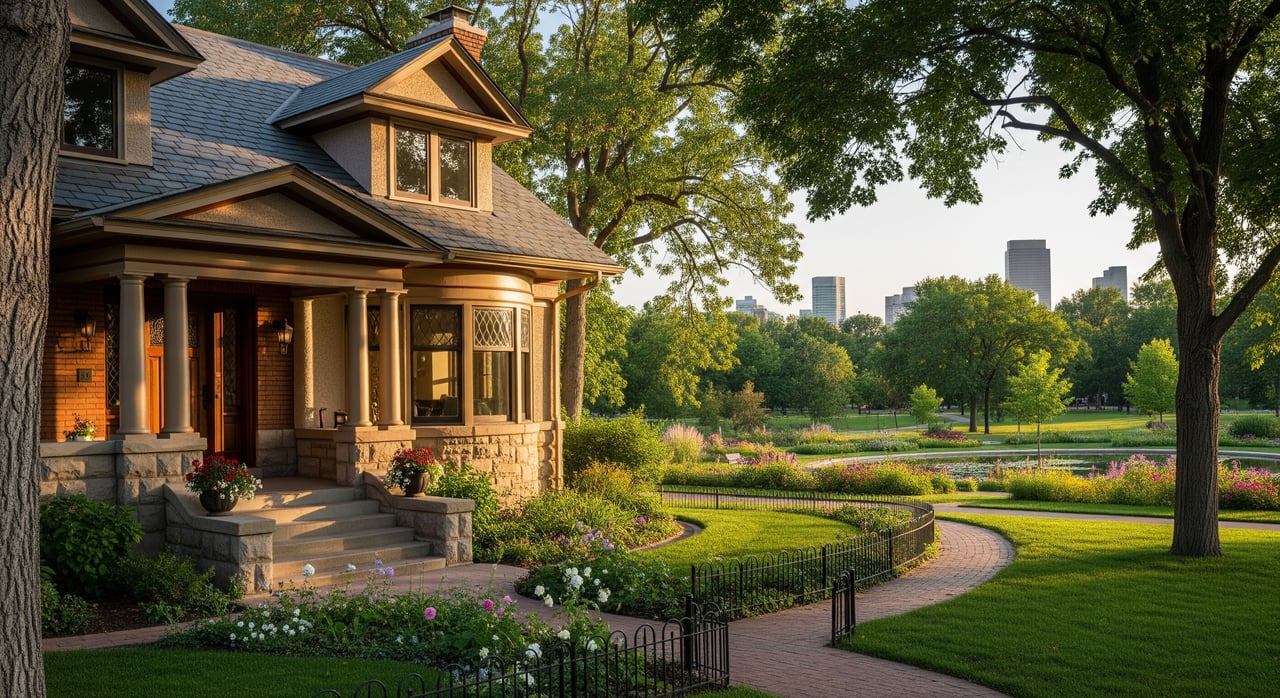
In February 2025, Tony and Robin Kohake closed on a house at 800 S. Franklin Street, directly across from Washington Park, for $2.6 million. They didn't buy it for the house. The two-story structure dated to 1884, had dry rot, a cracked foundation, missing flooring, and holes in the walls. The Kohakes wanted the 11,600-square-foot corner lot, and their plan was simple: demolish the existing structure and build a Tudor-style family home for their four kids.
That is a familiar story in Washington Park, where older homes on generous lots regularly get replaced with larger new construction. What happened next is the part most buyers never see coming, and it is the reason anyone shopping for a teardown candidate near the park needs to understand a process that has almost nothing to do with the condition of the house.
The Fight Nobody Priced Into the Deal
The Kohakes filed for a demolition permit in May 2025. Denver's landmark staff posted notice at the property, standard procedure for any older structure the city flags as potentially eligible for landmark status. Within weeks, residents filed Notices of Intent to pursue a designation, which extended the posting period into August. A city-hired mediator got involved. No resolution was reached.
By late August, three residents, Jody Debs, Stefanie Jacobs, and Susan Holbrook, filed a formal application asking Denver to name the house an individual landmark. If approved by City Council, that designation would have blocked the demolition the Kohakes had planned their entire project around. The application cost $875 to file.
Denver's Landmark Preservation Commission heard the case on September 16, 2025, four months after the demolition permit was submitted. The vote split 3-3. Under the city's process, an application needs five votes to advance to City Council. It failed. You can read the commission's staff report in full, including the criteria the applicants tried to satisfy and the reasons staff pushed back on some of them.
Here is the number that matters most to anyone eyeing a similar purchase. Denver's own assessor valued the existing structure at $1,000. The Kohakes paid $2.6 million for the land underneath it. Tony Kohake told BusinessDen that a successful designation would have cost his family "well over a million dollars," since the property's value is almost entirely tied to what can be built there, not what currently stands on it.
How Three Neighbors Can Freeze Your Build for Less Than a Home Inspection Costs
The mechanism here is worth understanding on its own terms, separate from this specific address. Filing an individual landmark application in Denver costs $875. There is no requirement that the applicants own the property, live next door, or have any financial stake in the outcome. Once filed, the application triggers a public hearing before the Landmark Preservation Commission, a body that evaluates whether a structure meets criteria tied to architectural style, historical association, or prominence within its neighborhood, not whether it's livable, safe, or wanted by its owner.
That last distinction is the one buyers most often miss. The Kohakes commissioned their own inspection ahead of the hearing, documenting deteriorating brick in the foundation, damaged subfloor joists, and unstable structural support throughout the home. They submitted that report as evidence the house didn't deserve protection. It didn't settle anything, because the ordinance doesn't ask whether a structure is sound. It asks whether the structure embodies a recognizable architectural style, whether it's tied to a historically significant person or event, or whether it functions as a familiar, prominent feature of its block. A condemned building can still check those boxes.
For a buyer, that means the inspection contingency you're used to negotiating around wiring, plumbing, and foundations does nothing to protect you from this particular risk. The only inspection that matters here is a look at how the block feels about change before you write the offer.
This Isn't the First Time, and It Won't Be the Last
The 800 S. Franklin fight was the second one over that exact address in roughly four years. Back in 2021, a different owner applied for a demolition permit on the same house. Neighbors organized then too, a mediator got involved, and the two sides reached an agreement: the owner withdrew the permit application, and the neighbors agreed not to file for landmark designation. That standoff held until the property changed hands again and the Kohakes bought it in 2025, at which point the whole cycle restarted with a formal application this time instead of a handshake deal.
A comparable case unfolded in South Park Hill in 2024, when neighbors tried to landmark a house on Montview Boulevard. That application was rejected 6-0, a clean, decisive vote compared to the 3-3 split at Franklin Street. The house was later demolished, and a new home now stands on the lot. Mark Rinehart, the property's owner, later spoke against the Franklin Street application, arguing that if the Montview case was too weak to justify landmark status, the Franklin application was weaker still.
Two things follow from comparing these outcomes. A unanimous rejection tends to end the matter cleanly and fast. A split vote, even a failed one, signals a genuinely divided neighborhood, and divided neighborhoods have more capacity to organize again, whether through a second application, a City Council appeal, or simple delay that runs up carrying costs on two properties at once. Robin Kohake described the process as adding "months and months" to a timeline that was already stressful before the landmark discussion started.
What to Check Before You Write the Offer
Anyone considering an older home near Washington Park with plans to demolish or substantially alter it should build a few extra steps into due diligence, ahead of the usual inspection and title work.
- Check the property's landmark status and registered neighborhood organization affiliations before making an offer, not after. Denver's zoning and landmark maps are public.
- Walk the block and look for context. Are there recent teardowns nearby, and how were they received? Yard signs opposing a scrape are a real signal of organized resistance, not just neighborhood chatter.
- Budget for the possibility of a mediation period. Denver requires facilitated conversations between owners and neighbors when a Notice of Intent is filed, and that process alone can extend a timeline by months before any vote happens.
- Bring in an architect who has worked through Denver's landmark and design-review process before, not just a builder. A design that respects a home's massing and setback from the street can reduce the odds of a fight escalating in the first place.
- Understand the Certificate of Non-Historic Status pathway as an alternative route for clearing a demolition question earlier in a purchase, rather than discovering the exposure after you're under contract.
None of this changes the fundamentals of what makes Washington Park worth buying into: the park itself, the tree canopy, the walk to South Gaylord or South Pearl. It changes how you sequence a purchase when redevelopment is the plan from day one.
A Few Questions Worth Asking Directly
Does a clean inspection protect me from a landmark fight? No. The criteria the Landmark Preservation Commission applies are about architectural style, historical association, and prominence in the neighborhood. A structural inspection report can support an argument against preservation, as the Kohakes' did, but it isn't a defense the ordinance recognizes on its own.
How much time could this realistically add? In the Franklin Street case, four months passed between the demolition permit application in May and the commission's vote in September, and that was before any City Council review would have started had the application advanced. Treat that as a floor, not a ceiling, for a contested property.
Is this only a Washington Park issue? The process applies citywide whenever a demolition permit is filed on a structure Denver's landmark staff flags as potentially eligible. Older homes on prominent corners or across from parks tend to draw more attention, which makes Wash Park a common setting for these disputes, but the same exposure exists in any Denver neighborhood with a comparable housing stock.
Buying with a redevelopment plan in Washington Park can still work out exactly as intended. It just requires treating the neighborhood's temperature as seriously as the home's foundation. If you're weighing a property like this and want a second set of eyes on what the block is likely to do before you're under contract, Let Me Guide You Home works with buyers across South Denver on exactly this kind of due diligence. Work With Us before you write the offer, not after.